Start with the units beside each number
A gas meter measures volume. A gas bill can show volume in cubic metres or a scaled unit, and energy in MMBtu. These are different quantities. HM³ on a gas bill is commonly used for hundreds of cubic metres; follow the legend and calculation on the actual provider document.
Subtracting the previous meter reading from the current one is only the starting point. Billing can apply corrections before converting volume to energy. Do not treat the raw reading difference as MMBtu or multiply it by an electricity rate.
Make a calculation note from your own bill
| Record from the same billed period | Why it belongs in the note |
|---|---|
| Previous and present meter reading, each with its date | Identifies the difference and the length of the period. |
| Meter/volume unit and any corrected-volume field | Prevents using a raw counter value as billed energy. |
| GCV value with its printed unit and pressure/correction information | Shows which conversion inputs the statement uses. |
| Billed MMBtu and stated category | Identifies the energy and classification actually being charged. |
| Energy charge and each separate remaining line | Lets you reconcile the amount without adding a subtotal twice. |
If a factor or unit is not printed, leave that entry unknown and ask for it. Filling the gap with another household’s GCV can produce plausible arithmetic that still does not explain your statement. For SNGPL, the official bill estimator provides separate reading, GCV, pressure, HM3 and MMBTU fields; follow its meter-entry instructions when using that service.
Using SNGPL’s official bill estimator
The official SNGPL estimator currently instructs users with cubic-metre meters to enter the complete eight-digit counter reading. Do not shorten that entry to a bill’s HM3 figure: the estimator arranges HM3 itself. Read its current instructions before entering anything.
Keep the previous/current readings and dates from the same period. Use the bill’s own GCV and pressure information; leave an unknown factor unresolved rather than borrowing a neighbour’s value. Account details belong only on the official service. This is an input checklist, not confirmation that a displayed tariff is current or that its estimate is your payable balance. SSGC users should follow SSGC’s own billing instructions.
Understand the conversion without mixing units
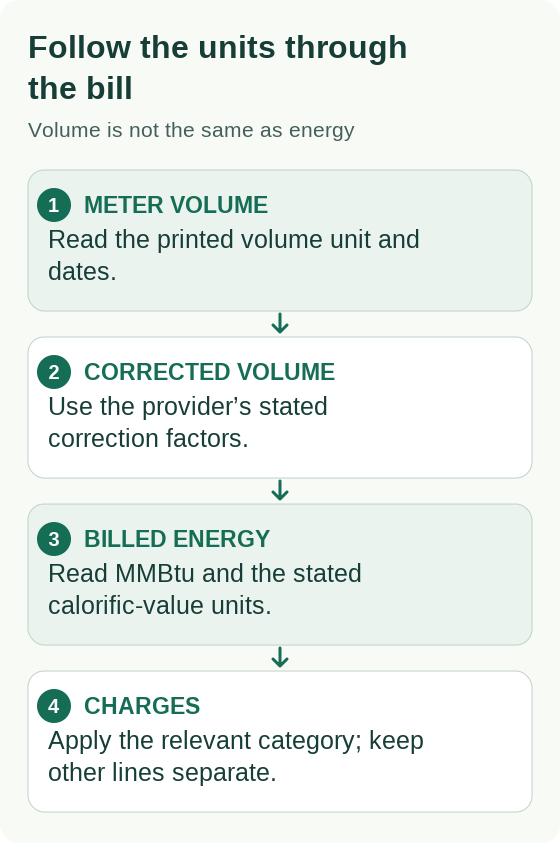
| Field | Meaning for the calculation |
|---|---|
| Metered volume | Difference in the relevant meter readings and units. |
| Corrected volume | Volume after the applicable billing correction factors; inspect the provider’s own calculation. |
| GCV / calorific value | Energy content per volume, expressed in the unit stated on the bill. |
| MMBtu | A million British thermal units: the energy quantity to which an energy-based gas rate can apply. |
For a purely illustrative unit conversion, assume 100 cubic metres of already-corrected gas volume and a calorific value of 1,000 Btu per cubic foot. Using about 35.3147 cubic feet per cubic metre gives about 3.53147 MMBtu. This is not a rate, a default GCV or a prediction for a real account.
If the bill’s GCV uses a different unit, that example formula is not directly applicable. Ask the provider for the calculation rather than copying an unexplained conversion factor.
Check the gas category before multiplying
Domestic classification, billing period and the current notified gas schedule matter. Gas protected status is not the same test as electricity protected status. A month’s low gas use does not by itself explain how the account was classified.
Use the applicable provider price notice and gas tariff definition. The site does not offer a “one rate for all gas bills” calculator or reuse electricity slab rates. A historical tariff table can be misleading if its effective period or category differs from your bill.
Keep energy charges separate from other lines
Read any fixed or minimum charges, meter-related charges, taxes, adjustments, prior balance and credits separately. The final payable amount is not always just MMBtu multiplied by a headline price. A low consumption entry does not prove that every other line should disappear.
| Mismatch | What to request |
|---|---|
| Meter volume looks wrong | The previous/current readings, reading dates and any correction or estimated-reading explanation. |
| MMBtu differs from your arithmetic | The volume basis, GCV unit and conversion factors used for the period. |
| Category or rate looks wrong | The account classification and applicable price notification. |
| Payment is missing | Reconciliation using the payment service’s receipt and transaction reference. |
Use the correct gas provider for follow-up
SNGPL and SSGC have separate consumer services. Open the SNGPL guide or SSGC guide according to your issued bill. PITC electricity complaint tools do not correct a gas account.
Keep your gas account number private except when using the official provider or payment process. For suspected leakage, move to safety and use the provider’s emergency instructions; a billing worksheet and this site’s contact form are not emergency services.
Questions you may have
Is one cubic metre the same as one MMBtu?
No. One is volume and the other is energy. Conversion depends on the stated units and calorific value.
Can I use the electricity protected-status checker for gas?
No. That worksheet addresses an electricity consumption condition. Gas categories have their own applicable rules.
Sources & scope
The sources below explain the service or rule discussed on this page. Use your provider’s records for an individual account.
- SNGPL: domestic bill estimatorIts field labels and meter-entry instructions were checked 30 September 2026. No displayed gas-price table is adopted here as a current rate.
- SNGPL: tariff definitionDescribes classes of consumer. It is not a dated notification establishing a current household rate.
- SSGC official bill pageSui Southern’s separate customer-number lookup and notices.