
Check your bill online in Pakistan.
Choose the electricity or gas company printed on your bill. Enter its reference, consumer or customer number to open the official provider portal, where you can view your copy. The tools below help you understand its units and charges.
Find your bill
Free to useYou finish on the official website. We check the number’s format, try to copy it, and open the provider portal. Paste or re-enter it there. We do not retrieve or issue bills.
Independent of the utility. Your bill number is processed in this browser; our helper does not send it to our server.
- Official PITC portal
- No account, no signup
- Number processed in your browser
- Guides checked against official sources — last checked 21 Nov 2026
- 1Choose the company on your bill
- 2Copy your account identifier
- 3Finish on the official portal
Check your electricity or gas bill online in 3 steps
- Find the number on your bill. For electricity it is the 14-digit reference number; for SNGPL/SSGC gas it is the consumer or customer number printed on the bill.
- Choose your company above and enter the number. The helper checks the format and copies the number for you. Your number is processed in your browser and is not sent to our server.
- Finish on the official portal. The helper opens your provider’s own website (PITC for electricity companies, the gas company’s portal for gas). Paste the number there to view, download or print your bill copy.
PakistanBillCheck does not retrieve or issue bills. The provider controls the bill, the account information and the payment record.
The 14-digit reference number, explained
Every electricity bill in Pakistan carries a 14-digit reference number, printed near the top of the bill under “Reference No.” It is the key that identifies your connection. Keep every digit, including leading zeros — a missing zero opens the wrong account or no account at all. Spaces and dashes between digit groups are fine; the portal ignores them.
The last character of the reference number is usually a letter: U for Urban or R for Rural. It tells the company whether the connection is in an urban or a rural area. Do not replace it with a digit, and do not add it if your bill does not show it — enter the number exactly as printed.
Three things the reference number is not
- It is not your Customer ID. Some companies, including LESCO, also print an Customer ID. The official portal asks you to choose one or the other — select the option that matches the number you have, and do not pad one number to make it fit the other.
- It is not your meter number. The meter number identifies the equipment on your wall, not your account, and the portal cannot search by it.
- It is not your CNIC or phone number. No official electricity portal in Pakistan lets you search a bill by CNIC, name or mobile number. Any website that asks for your CNIC to “show your bill” is not the official portal.
For gas bills the identifier is different: SNGPL and SSGC use a consumer or customer number printed on the gas bill. The same rule applies — copy it exactly as printed, including leading zeros.
If you have lost your bill, the reference number is also printed on older bills, on payment receipts and, for many people, in the SMS the company sends when a bill is issued. Without any of these, only your subdivision office can look the number up for you.
Current electricity tariff slabs and FPA
Last checked: 21 November 2026. Base rates are the national uniform residential schedule under S.R.O. 279(I)/2026, effective 12 February 2026. They are the same for LESCO, MEPCO, FESCO, GEPCO, IESCO, PESCO, HESCO, SEPCO, QESCO and TESCO. Rates are per unit (Rs/kWh) before taxes and adjustments. Always compare with your latest bill — your bill is the final word.
Lifeline — very small users
Sanctioned load under 5 kW.
Scroll → to see all columns
| Monthly units | Rate per unit | Fixed charge |
|---|---|---|
| 1–50 | Rs 3.95 | None |
| 51–100 | Rs 7.74 | None |
Lifeline users pay no fixed charge and get no slab benefit. A minimum monthly charge can apply where no fixed charge does — check the amount on your bill.
Protected — 200 units or less
Scroll → to see all columns
| Monthly units | Rate per unit | Fixed charge per kW |
|---|---|---|
| 1–100 | Rs 10.54 | Rs 200 |
| 101–200 | Rs 13.01 | Rs 300 |
Protected is the only category that gets the benefit of one previous slab: a protected home using 150 units pays 100 × Rs 10.54 plus 50 × Rs 13.01 = Rs 1,704.50 in energy charges.
Non-protected — everyone else
Scroll → to see all columns
| Monthly units | Rate per unit | Fixed charge per kW |
|---|---|---|
| 1–100 | Rs 22.44 | Rs 275 |
| 101–200 | Rs 28.91 | Rs 300 |
| 201–300 | Rs 33.10 | Rs 350 |
| 301–400 | Rs 36.46 | Rs 400 |
| 401–500 | Rs 38.95 | Rs 500 |
| 501–600 | Rs 40.22 | Rs 675 |
| 601–700 | Rs 41.85 | Rs 675 |
| Above 700 | Rs 47.20 | Rs 675 |
Non-protected homes get no slab benefit: the rate of the slab your monthly total lands in applies to every unit that month. A non-protected home using 150 units pays 150 × Rs 28.91 = Rs 4,336.50 in energy charges — the same 150 units cost a protected home Rs 1,704.50. That is why staying under 200 units matters so much.
What else is added to the bill
On top of the energy charge and the fixed charge (fixed charge = rate per kW × your sanctioned load in kW, printed on the bill), a bill normally carries:
- Fuel Price Adjustment (FPA / FCA). This changes every month. For November 2026 bills, NEPRA approved Rs 2.3673 per unit for electricity used in September 2026, under its November 2026 notification. It appears as a separate line and is charged on September’s units, not November’s. A home that used 300 units in September pays about Rs 711 extra. Lifeline consumers, EV charging stations and prepaid-tariff consumers are exempt. Check the FPA line on your own bill each month — last month’s figure never applies to this month.
- FC surcharge. Rs 3.23 per unit for non-protected consumers and Rs 0.43 per unit for protected consumers, per the published tariff guides.
- Quarterly Tariff Adjustment (QTA). A per-unit adjustment that changes every quarter — check the figure on your latest bill.
- GST and other taxes. GST, electricity duty, TV fee and other small charges are added after the energy and fixed charges — the exact rates are printed on your bill.
Use the electricity bill calculator to estimate your bill from your units, and read every charge line explained if a line on your bill is unfamiliar.
The protected 200-unit rule
A home is protected only if it uses 200 units or less in every month for six consecutive months. Protection is not decided by one month alone — it is decided by the last six months together.
Cross 200 units in even one month and you lose protected status. From that month on, the whole month is billed at the non-protected rate on every unit, and the fixed charge rises too. Protection returns only after six straight months back at or under 200 units.
This is why one extra unit can be expensive: a home at 200 units pays protected rates; the same home at 201 units pays the non-protected 201–300 slab rate (Rs 33.10 per unit) on all 201 units, not just the one extra unit.
Two things to know:
- The 200-unit limit has not changed. In October 2026 the Power Minister told the Senate the protected limit is planned to rise from 200 to 250 units. As of 15 November 2026 nothing has been notified, so the 200-unit rule is what your bill follows.
- Only protected consumers get the benefit of one previous slab. Lifeline consumers get no slab benefit at all, and neither do non-protected consumers.
Read the full comparison in protected vs unprotected slabs.
How to pay, and how long payment takes to show
Pay before the due date printed on the bill. A late-payment surcharge is added after the due date, and the amount payable after the due date is a different figure from the amount payable before it.
Scroll → to see all columns
| Method | Where to pay | When it usually shows as paid |
|---|---|---|
| JazzCash app or agent | Pay Bills → Electricity → your company → 14-digit reference number | Typically within a few hours; can take up to 24–48 hours. Timings vary by bank and channel. |
| Easypaisa app or agent | Pay Bills → Electricity → your company → 14-digit reference number | Typically within a few hours; can take up to 24–48 hours. Timings vary by bank and channel. |
| Bank mobile app / internet banking | Utilities / Bill Payment → your company → reference number | Typically 1–2 working hours during banking hours; next working day if paid late or on a weekend. Timings vary by bank and channel. |
| ATM (1-Link network) | Bill Payment → your company → reference number | Processed within 1–2 hours; confirmed by the next business day |
| Bank branch counter | Any bank branch, with the bill or reference number | Same day or next business day |
Keep your payment receipt or transaction SMS until the portal shows the bill as paid — allow up to 24–72 hours for the status to update. If the portal still shows the bill unpaid after that, take the receipt and transaction ID to your subdivision office; the receipt is your proof. For the full step-by-step for each method, see online bill payment methods.
Frequently asked questions
How can I check my electricity bill online in Pakistan?
Find the 14-digit reference number on your bill, choose your company on this page, and open the official PITC portal to view your bill copy. PakistanBillCheck checks the number's format and opens the portal — it does not fetch the bill itself.
What is the 14-digit reference number?
It is the account number printed on your electricity bill under "Reference No." Keep every digit, including leading zeros. The last character is usually U for Urban or R for Rural.
Can I check my bill with my CNIC, meter number or phone number?
No. No official electricity portal searches by CNIC, name, mobile number or meter number. Use the reference number — or the Customer ID where your company offers that option.
What is the difference between protected and unprotected consumers?
A protected home uses 200 units or less every month for six months and pays Rs 10.54–13.01 per unit. Everyone else is non-protected and pays Rs 22.44–47.20 per unit, with the month's slab rate applied to every unit. See protected vs unprotected slabs.
Why did my bill jump so much when I used just a few more units?
Because non-protected billing has no slab benefit: crossing into a higher slab reprices every unit that month at the higher rate. One unit over 200 can move the whole bill from protected to non-protected rates.
What is FPA on my bill?
FPA (Fuel Price Adjustment) is a monthly charge that passes fuel-cost changes through to consumers. For November 2026 bills it is Rs 2.3673 per unit on September's consumption, under NEPRA's November 2026 notification. It changes every month, so check the FPA line on your own bill.
How long does an online payment take to appear as paid?
Typically a few hours for JazzCash and Easypaisa, and 1–2 working hours for bank apps during banking hours. It can take up to 24–48 hours, and timings vary by bank and channel, so keep your receipt until the portal shows the bill as paid.
I never received a paper bill. Do I still have to pay?
Yes. Not receiving the paper copy does not cancel the bill. Check the amount online with your reference number and pay before the due date. If no bill appears online either, contact your subdivision office — do not wait for the paper copy.
To use less electricity in the expensive hours, read the peak hours saving guide. If your bill carries a subsidy QR code, see what it means before you scan it. And if a reading or charge looks wrong, prepare a complaint with the evidence the company will ask for.
One bill. The right place.
Use the company printed on your latest bill. The provider controls the bill, account information and payment record.
Go beyond the payable amount.
Estimate base charges
See the energy and fixed-charge calculation under the named residential schedule. Monthly adjustments and taxes are separate.
Open the calculator →Compare two bills
Enter the charge-line amounts from two bills. See which groups changed and check whether your copied amounts add up.
Compare the amounts →Prepare a complaint
Describe the exact issue, keep the evidence and use the appropriate official service.
Find your next step →Bill calculators: LESCO bill calculator · MEPCO bill calculator · FESCO bill calculator · IESCO bill calculator · Peak hours: LESCO peak hours · MEPCO peak hours · FESCO peak hours · IESCO peak hours
Practical guides, one question at a time.
Every portal in the 'Verified' rows below loaded in this check. Rows marked 'Not re-fetched' give the URL as linked on this site — they were not re-tested in this check, and must not be read as tested.
| Provider | Portal URL | What you need | Last-checked date | Status in this check |
|---|---|---|---|---|
| LESCO | Open LESCO portal | 14-digit Reference No, or Customer ID | 1 Oct 2026 (PBC form check; not re-fetched 21 Nov 2026) | Not re-fetched in this check — portal did not load in this browser (connection reset, twice; not evidence the portal is down). URL as linked on this site; not re-tested in this check, and must not be read as tested. PBC form recorded 1 Oct 2026. |
| MEPCO | Open MEPCO portal | 14-digit Reference No, or Customer ID | 19 Sep 2026 (PBC form recorded; not re-fetched 21 Nov 2026) | Not re-fetched in this check — portal did not load in this browser (connection reset, twice; not evidence the portal is down). URL as linked on this site; not re-tested in this check, and must not be read as tested. PBC form recorded 19 Sep 2026. |
| FESCO | Open FESCO portal | 14-digit Reference No, or Customer ID | 19 Sep 2026 (PBC form recorded; not re-fetched 21 Nov 2026) | Not re-fetched in this check — portal did not load in this browser (connection reset, twice; not evidence the portal is down). URL as linked on this site; not re-tested in this check, and must not be read as tested. PBC form recorded 19 Sep 2026. Crawl cache 17 Jul 2025 was the oldest of the three. |
| Suthra Punjab | Open Suthra bill check | 20-digit PSID | 21 Nov 2026 | Verified — curl HTTP 200, 21 Nov 2026: PSID lookup form, helpline 1139, no login required. Re-confirmed by curl in this task. |
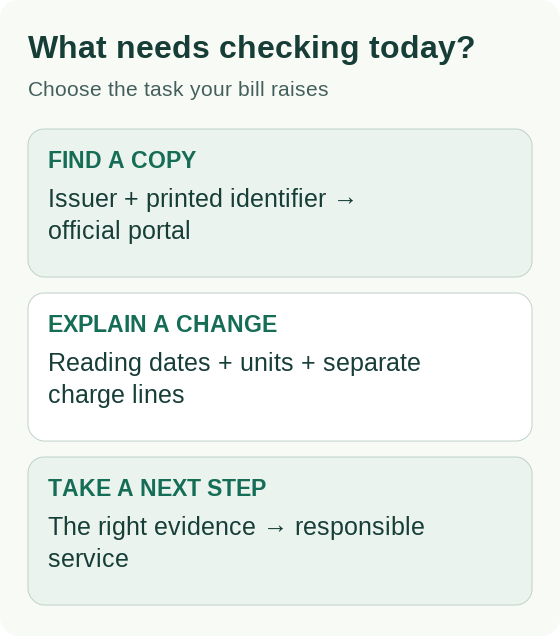
Find a clear explanation, a practical check and the official next step.
Start with the details, not just the total.
The reference identifies the account. The billing month identifies the period. Readings, tariff and load explain how the calculation starts.
Walk through the charge lines →Independent, with sources you can follow.
PakistanBillCheck is maintained by Muhammad Muzamil. It is not a utility company or government service. We explain the steps; official providers issue bills and handle account decisions.
Meet the maintainer →Something looks wrong?
Send the page link and the specific statement or broken destination. Please leave out reference numbers, CNICs and private bills.
Report a correction →