Keep the bill, payment receipt and complaint number as three separate records. A bank debit notification alone does not explain whether the utility payment completed.
Check what the document actually proves
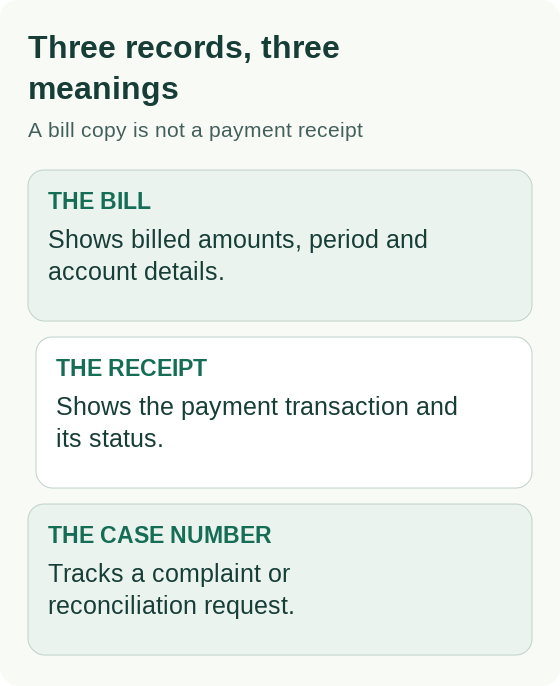
A SEPCO duplicate bill tells you what the provider has billed for the period shown. A bank or wallet receipt records a payment transaction. Do not assume that opening or downloading the bill means it has been paid.
| Document | Use it to check |
|---|---|
| Issued SEPCO bill | Account identity, billing month, charges and due date. |
| Payment receipt | Biller, account identifier, paid amount, transaction reference and status. |
| Complaint record | The issue reported, date, case number and follow-up. |
Save documents in a private folder with the billing month. Do not include your complete reference number in a publicly shared file name or an online help request.
Reading-subtraction worksheet — work out the units before the rupees
The billed units come from the readings, not from the rupee total. The formula is: (present reading − previous reading) × multiplying factor = billed units.
Example 1 — multiplying factor 1: previous reading 18,420 kWh, present reading 18,905 kWh. 18,905 − 18,420 = 485 kWh; 485 × 1 = 485 units.
Example 2 — multiplying factor 2: previous reading 9,100 kWh, present reading 9,340 kWh. 9,340 − 9,100 = 240; 240 × 2 = 480 units. The factor matters as much as the readings: the same 240-unit difference bills as 480 units when the factor is 2, so always read the factor printed on the bill before subtracting.
Pricing Example 1 (illustration, assuming non-protected, 1 kW): energy 485 × Rs 38.95 = Rs 18,890.75 (485 units falls in the 401–500 slab); fixed charge Rs 500 × 1 kW = Rs 500.00; FPA 485 × Rs 2.3673 = Rs 1,148.14; QTA 485 × Rs 0.5194 = Rs 251.91; FC surcharge 485 × Rs 3.23 = Rs 1,566.55. Total before taxes: Rs 18,890.75 + Rs 500.00 + Rs 1,148.14 + Rs 251.91 + Rs 1,566.55 = Rs 22,357.35. The category is an assumption for this illustration — the real bill’s category is decided by the last six months of that connection’s use, and the real total must be checked against the category printed on the bill.
How we verified the figures on this page — see 'How we verified this page' above (Last checked 21 November 2026 against PITC and NEPRA).
Before you confirm a payment
- Open the correct SEPCO accountMatch the reference, customer/service details and bill month on PITC. If the bill names HESCO, use its separate route.
- Check the biller in your payment appUse the supported SEPCO bill-payment entry and the identifier it requests. Do not add an invented prefix or use a personal transfer as a bill payment.
- Read the confirmation screenCompare the fetched account and payable amount before authorising payment in the official banking or wallet app.
- Keep the transaction referenceSave the completed status and receipt. PakistanBillCheck does not take money or receive payment confirmation from your bank.
A QR code is not automatically a payment code. Read its surrounding label and verify the destination; the QR guide explains the difference between information and payment links.
| Document | What it shows | When you need it |
|---|---|---|
| The bill | The account, the billing period, the readings and the units, the amount payable, and the due date | To check the charges and to pay; a later copy can show a different balance, so read the issue date, reading period and due date on each copy |
| The payment receipt | That a payment was made, the amount, the date and the channel | To prove a payment when a debit happened but the bill still looks unpaid; keep the receipt with the bill it paid |
| A later copy of the same bill | The same account at a later date — new charges, a correction or an earlier outstanding amount can change the payable balance | When a balance changes between copies: compare issue dates and reading periods before assuming a payment was lost |
They belong to different systems and are useful together: the bill proves what was charged, the receipt proves what was paid. If a debit happened but the bill still looks unpaid, keep both documents and ask the utility to reconcile that period. How we verified the figures on this page — see 'How we verified this page' above (Last checked 21 November 2026 against PITC and NEPRA).
If a debit happened but the bill still looks unpaid
| What the payment record says | What to check next |
|---|---|
| Pending, failed or reversed | Ask the bank or wallet to explain that transaction’s status using its transaction reference. A utility bill alone cannot explain a bank-side status. |
| Successful, but account or biller differs | Show the payment service the mismatch and ask what correction process applies. Do not assume a second payment reverses the first one. |
| Successful, correct SEPCO account, balance still present | Keep the full receipt and issued bill together; ask the provider to reconcile the payment for that account and period. |
A useful private request is: “Please reconcile the payment for [bill month], made on [payment date] for [amount]. The payment service shows [status], with transaction reference [reference], but the bill still shows [specific balance line].” Add the account identifier only in the appropriate official channel. Keep the response and complaint number with your receipt. A bank debit notification alone does not confirm a completed utility payment.
A later copy can show a different balance
Read the issue date, reading period and due date on each copy. New charges, a correction or an earlier outstanding amount can change the payable balance. When asking about a difference, name both periods and the exact changed line instead of comparing only the final totals.
Compare the dates before treating arrears as a second bill
Suppose you saved a SEPCO bill, paid it, then opened another issued copy showing a balance. Build a short timeline from the documents you already have. The date you downloaded a PDF is not necessarily its issue date, and a payment-app success screen is not a utility posting record.
Fictional record example, not an actual SEPCO account or tariff calculation: all dates and amounts below are invented to show which question to ask. No account identifier is needed.
| Record | What is visible | What it cannot establish |
|---|---|---|
| Earlier issued bill: 3 September | September bill; Rs 4,800 before its printed due date. | Whether a later payment was completed or credited. |
| Receipt: 12 September | Payment service marks Rs 4,800 successful for the same SEPCO account. | When SEPCO posted it, or whether the October balance is correct. |
| Next issued bill: 4 October | October bill shows a Rs 4,800 arrears line as well as new charges. | Why that amount is carried forward; the matching figure alone is not a reconciliation. |
In this example, ask about the Rs 4,800 carried-forward line, attaching both full bills and the matching receipt through the official channel. Do not add the September total to the October payable amount yourself: the later bill may already include that earlier balance. Equally, do not subtract it yourself and assume that the remainder is an authorised payment amount.
Turn the comparison into one precise SEPCO request
- Check that the records belong togetherMatch the printed provider and account on both bills and the receipt. If the receipt belongs to HESCO or another account, use the payment service to investigate that mismatch.
- Name the changed lineRecord each bill month and issue date, the payment date, and whether the difference is in current charges, arrears, an adjustment or the after-due-date amount. Copy the labels as printed; a larger total alone does not identify the cause.
- Ask what was postedRequest the payment posting date and the explanation for the carried-forward amount. If an adjustment was made, retain its written reference and the corrected bill. Leave a field marked “not shown” when a document does not supply it.
If the earlier bill was issued before your payment, that bill cannot by itself show a later posting. If a subsequent bill still carries the disputed balance, the two bills and receipt make the question specific; they do not prove which system is wrong. Ask SEPCO how to handle the payable amount and due date while the case is reviewed. PakistanBillCheck cannot suspend a bill, authorise a deduction or confirm a payment.
The NEPRA Consumer Service Manual, revised 26 November 2025, clauses 10.3.1(i) and 10.3.2, covers paid amounts appearing in a later bill and registration through the subdivision, Consumer Service Centre or One-Window office. Use your bill’s SEPCO service contact or the complaint route below and retain its acknowledgement.
SEPCO support and complaints
For a SEPCO reading, balance or supply issue, use PITC’s electricity complaint portal or the complaint contact printed on your current bill. Save the case number so you can follow up on the same issue.
For an error in this guide, contact PakistanBillCheck with the page link and the sentence or broken link. Leave out your private account details.
Where SEPCO supplies — area note
No district list is drafted here: no district-list section was found on the live SEPCO page as fetched in this task (21 November 2026), so no district names are listed rather than guessed. At implementation, take the district list from SEPCO’s own published area list and add it here with its source — do not copy a list from another site. What the page does establish: SEPCO is the Sukkur Electric Power Company, and it is a separate provider from HESCO and K-Electric. There is no SEPCO calculator on this site — use the electricity bill calculator for an estimate.
How we verified the figures on this page — see 'How we verified this page' above (Last checked 21 November 2026 against PITC and NEPRA).
Questions you may have
Do you accept SEPCO payments?
No. This is an independent guide and portal helper. Pay only through a provider-supported bank, wallet or collection channel.
Should I pay again if a balance is still visible?
Check transaction status and request reconciliation first. A second payment can create another transaction without explaining the first one.
What number should I retain after a complaint?
Keep the official complaint ID as well as the bank transaction reference. They belong to different systems and are useful together.
How we verified this page
Last checked 21 November 2026 against PITC and NEPRA. What was actually checked:
- The official bill portal for SEPCO loaded and showed separate Reference No and Customer ID searches — public form recorded 19 September 2026. No private bill was retrieved and no account was submitted.
- The tariff rates on this page were read from NEPRA's uniform residential tariff, S.R.O. 279(I)/2026, Annex A-1 (effective 12 February 2026).
- The November 2026 fuel adjustment (Rs 2.3673/unit) is NEPRA S.R.O. 2094(I)/2026, decided 6 November 2026; the quarterly adjustment is Rs 0.5194/unit (S.R.O. 1501(I)/2026, 4 September 2026). The financing-cost surcharge is Rs 3.23/unit non-protected and Rs 0.43/unit protected (S.R.O. 1157(I)/2025, 1 July 2025).
- PITC SEPCO form recorded 19 September 2026: Reference No and Customer ID are separate searches. Bill-vs-receipt separation as stated on this page; tariff rates from S.R.O. 279(I)/2026 Annex A-1.
- What we did not check: your individual account, meter reading or payment record. Those remain with SEPCO; this site never asks for your CNIC, bank details or OTPs.
If a figure on this page disagrees with your bill, the bill governs — and you can report the difference via contact (/contact/) with the page link and the sentence.
Sources & scope
The sources below explain the service or rule discussed on this page. Use your provider’s records for an individual account.
- SEPCO official bill portalPublic form recorded 19 September 2026: Reference No and Customer ID are separate searches. No private bill was retrieved.
- PITC Customer Complaint Management SystemOfficial electricity complaint route; availability for your account remains with the provider.