
Choose the right scope
This calculator uses the GoP notified rates in Annex A-1 of S.R.O. 279(I)/2026, dated 12 February 2026. It does not fetch a current monthly tariff, inspect your account, or determine eligibility. Later adjustments can change the payable amount without changing this base calculation.
- Non-ToU residential options apply below 5 kW sanctioned load.
- Lifeline is limited here to an eligible single-phase connection up to 1 kW and at most 100 units. Low use alone does not prove eligibility.
- Protected status needs the utility’s classification; do not select it just because this month is below 200 units.
- ToU needs at least 5 kW sanctioned load, separate peak/off-peak units and the actual MDI.
- Commercial, industrial, agricultural, temporary and other schedules are outside this calculator.
Using this for a PESCO, MEPCO or LESCO bill
The named February 2026 residential base schedule covers the XWDISCO categories, including PESCO, MEPCO and LESCO. Start with the category and sanctioned load on your own bill; the company name alone does not decide whether you are protected, unprotected or eligible for lifeline rates.
Use the billed kWh from the same period. For a ToU connection, enter peak and off-peak units separately with the actual MDI. A gas bill, industrial account or agricultural pump needs a different schedule. The estimate cannot read your account or select its category for you.
If you need the issued copy first, open the PESCO bill guide, MEPCO bill guide or LESCO bill guide. Each leads to its own official lookup. Then return here with the relevant units, category and load; no reference number is required by this calculator.
For a newer billing period, check the NEPRA PESCO tariff and adjustment register and the notification referenced on your bill. This February example excludes later fuel/quarterly adjustments, taxes, duties, levies, arrears, credits and late fees.
The rates used here
| Residential category / monthly units | Energy rate (Rs/kWh) | Fixed rate (Rs/kW/month) |
|---|---|---|
| Eligible lifeline · 0–50 | 3.95 | None |
| Eligible lifeline · above 50–100 | 7.74 | None |
| Protected · 0–100 | 10.54 | 200 |
| Protected · above 100–200 | 13.01 | 300 |
| Unprotected · 0–100 | 22.44 | 275 |
| Unprotected · above 100–200 | 28.91 | 300 |
| Unprotected · above 200–300 | 33.10 | 350 |
| Unprotected · above 300–400 | 36.46 | 400 |
| Unprotected · above 400–500 | 38.95 | 500 |
| Unprotected · above 500–600 | 40.22 | 675 |
| Unprotected · above 600–700 | 41.85 | 675 |
| Unprotected · above 700 | 47.20 | 675 |
| Residential ToU | 46.85 peak / 34.53 off-peak | 675 |
Only protected residential consumers receive one previous slab’s benefit under the schedule note. Unprotected and lifeline calculations use the applicable band’s rate for all units. Non-ToU fixed charges use sanctioned load; ToU fixed charges use the higher of 50% of sanctioned load and actual MDI. An eligible single-phase lifeline connection with zero consumption has the Rs. 75 minimum customer charge used here.
Why 250 unprotected units give Rs. 8,975
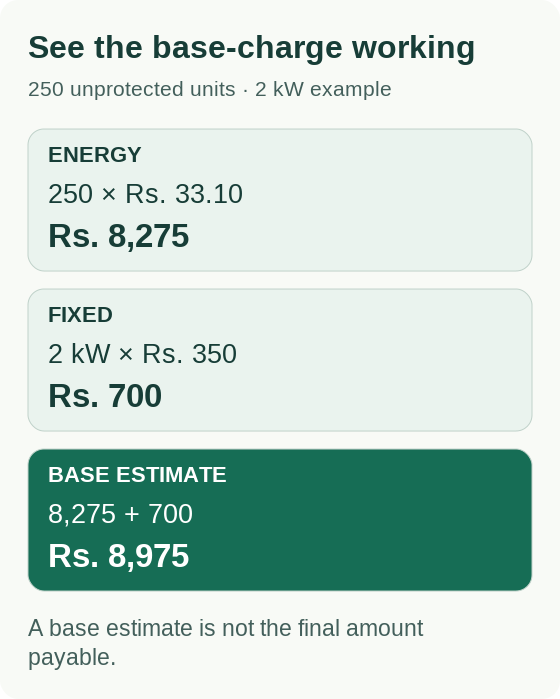
For 250 units and 2 kW sanctioned load: energy is 250 × Rs. 33.10 = Rs. 8,275. Fixed charges are 2 × Rs. 350 = Rs. 700. The resulting base estimate is Rs. 8,975 before other bill lines. This example does not distribute those units across the lower unprotected bands.
For 150 protected units at 2 kW: (100 × 10.54) + (50 × 13.01) + (2 × 300) = Rs. 2,304.50. The category changes the method as well as the rate.
Small fractional inputs can create rounding differences from utility billing systems. The calculator displays two decimals and cannot reconcile account-specific rounding or billing adjustments.
250, 400 and 600 units: compare the same base calculation
These worked examples use an unprotected residential connection with 2 kW sanctioned load under S.R.O. 279(I)/2026. The applicable band is used for all units, then the fixed rate is multiplied by the approved load. They are base examples before other bill lines, not current payable amounts for every household.
| Monthly units | Energy working | Fixed working | Base estimate (Rs.) |
|---|---|---|---|
| 250 | 250 × 33.10 = 8,275 | 2 × 350 = 700 | 8,975 |
| 400 | 400 × 36.46 = 14,584 | 2 × 400 = 800 | 15,384 |
| 600 | 600 × 40.22 = 24,132 | 2 × 675 = 1,350 | 25,482 |
The same units can produce a different base amount in another category. At 150 units and 2 kW, this schedule gives Rs. 2,304.50 for protected usage and Rs. 4,936.50 for unprotected usage. Confirm your billed category instead of choosing the smaller figure. For your own unit total, use the form above.
What the base estimate leaves out — FPA, QTA, FC surcharge and taxes
The form above gives base charges only: energy plus the fixed charge under the named February 2026 schedule. A real bill is built in this order: energy charge, fixed charge, fuel and quarterly adjustments, financing-cost surcharge, taxes. The worked examples below add the November 2026 adjustments to the base, so you can see how far the base figure is from the amount before taxes.
How each line is worked out
1. Energy charge. NEPRA sets one uniform residential schedule for the whole country under S.R.O. 279(I)/2026, effective 12 February 2026 — see the rates table above. A protected household is charged progressively at Rs. 10.54 and Rs. 13.01 per unit; an unprotected household pays the rate of the band its total falls in on every unit. Lifeline pays Rs. 3.95 (1–50 units) or Rs. 7.74 (51–100).
2. Fixed charge. A monthly charge per kW of sanctioned load, not per unit used: protected Rs. 200–300 per kW; unprotected Rs. 275–675 per kW by band (see the rates table above). Read the sanctioned load from the bill — this is not an appliance's wattage.
3. Fuel price adjustment (FPA). The gap between assumed and actual generation fuel cost. NEPRA sets it monthly, and it appears on bills about two months later. November 2026 bills: Rs. 2.3673 per unit (September 2026 consumption). October 2026 bills: Rs. 1.1086 (August 2026). Lifeline, EV charging and prepaid connections do not pay FPA. FPA changes monthly — re-check for later bills.
4. Quarterly tariff adjustment (QTA). Rs. 0.5194 per unit on September–November 2026 bills (April–June 2026 quarter), under S.R.O. 1501(I)/2026.
5. Financing-cost (FC) surcharge. Also called the Debt Service Surcharge: Rs. 3.23 per unit for unprotected consumers, Rs. 0.43 per unit for protected consumers (S.R.O. 1157(I)/2025, 1 July 2025).
6. Taxes. GST, electricity duty and, for some consumers, withholding tax are charged on the taxable amount. Rates and exemptions change and differ by category, so no single tax figure is stated here — check your own bill, and the guide to electricity bill taxes explained.
7. PTV fee: removed from electricity bills from 1 July 2025 — it no longer appears on your bill.
Protected or unprotected: the rule that decides your rate
You are protected if you used 200 units or less in each of the last six consecutive months. Your distribution company applies it automatically — no application, no form. Use 201 units even once and that month is billed as unprotected — and you stay unprotected for the next six months, even if usage drops back below 200. See protected vs unprotected slabs for the full rule. A protected household pays progressively at Rs. 10.54 and Rs. 13.01 per unit, with the Rs. 0.43 FC surcharge. An unprotected household pays the final band rate on every unit, with the Rs. 3.23 surcharge. Lifeline (100 units or less) is separate: Rs. 3.95 or Rs. 7.74 per unit, no fixed charge, no FPA.
The same 150 units, priced twice. Protected: 100 × Rs. 10.54 + 50 × Rs. 13.01 = Rs. 1,704.50 energy charge. Unprotected: the whole 150 units at the 101–200 band rate of Rs. 28.91 = 150 × Rs. 28.91 = Rs. 4,336.50. Same house, same units — Rs. 2,632 more. (1,054 + 650.50 = 1,704.50; 4,336.50 − 1,704.50 = 2,632.00.)
Worked example: 300 units with the November 2026 adjustments
Unprotected, 300 units, 1 kW load, November 2026: energy 300 × Rs. 33.10 = Rs. 9,930; fixed charge Rs. 350; FPA 300 × Rs. 2.3673 = Rs. 710; FC surcharge 300 × Rs. 3.23 = Rs. 969; Rs. 11,959 before taxes and QTA. (9,930 + 350 + 710.19 + 969 = 11,959.19.) At 300 units the all-in cost is roughly Rs. 40 per unit, not Rs. 33.10. Add QTA at Rs. 0.5194 per unit (300 × 0.5194 = Rs. 155.82, shown as Rs. 156) and the same example is Rs. 12,115 before taxes — the 300-unit row of the table below, and of the 100–500 table above the form.
Estimated bills from 100 to 1,000 units
Assumptions: 2 kW sanctioned load; FPA Rs. 2.3673 per unit (November 2026 bills); FC surcharge Rs. 3.23 unprotected, Rs. 0.43 protected. Totals are estimates before taxes and QTA (Rs. 0.5194 per unit on September–November 2026 bills), rounded to the nearest rupee. With a 1 kW load, halve the fixed-charge column; with 5 kW, multiply by 2.5.
| Units | Category | Energy (Rs) | Fixed, 2 kW (Rs) | FPA (Rs) | FC surcharge (Rs) | Estimated total (Rs) |
|---|---|---|---|---|---|---|
| 100 | Protected | 1,054 | 400 | 237 | 43 | ≈ 1,734 |
| 100 | Unprotected | 2,244 | 550 | 237 | 323 | ≈ 3,354 |
| 150 | Protected | 1,705 | 600 | 355 | 65 | ≈ 2,724 |
| 150 | Unprotected | 4,337 | 600 | 355 | 485 | ≈ 5,776 |
| 200 | Protected | 2,355 | 600 | 473 | 86 | ≈ 3,514 |
| 200 | Unprotected | 5,782 | 600 | 473 | 646 | ≈ 7,501 |
| 250 | Unprotected | 8,275 | 700 | 592 | 808 | ≈ 10,374 |
| 300 | Unprotected | 9,930 | 700 | 710 | 969 | ≈ 12,309 |
| 400 | Unprotected | 14,584 | 800 | 947 | 1,292 | ≈ 17,623 |
| 500 | Unprotected | 19,475 | 1,000 | 1,184 | 1,615 | ≈ 23,274 |
| 600 | Unprotected | 24,132 | 1,350 | 1,420 | 1,938 | ≈ 28,840 |
| 700 | Unprotected | 29,295 | 1,350 | 1,657 | 2,261 | ≈ 34,563 |
| 800 | Unprotected | 37,760 | 1,350 | 1,894 | 2,584 | ≈ 43,588 |
| 1,000 | Unprotected | 47,200 | 1,350 | 2,367 | 3,230 | ≈ 54,147 |
First, the jump from 200 to 201 units is the most expensive single unit on any bill: about Rs. 3,514 protected at 200 units, about Rs. 7,501 unprotected. Second, above 500 units the fixed charge stops rising but the energy charge keeps climbing, so every unit past 700 costs Rs. 47.20 before adjustments and taxes.
How to read the estimate on your real bill
Match your latest bill line by line. Units sit near the top, beside the present and previous readings — check the reading says "actual", not "estimated". The energy charge should match your category and band; the fixed charge, your sanctioned load times the per-kW rate; the FPA line, Rs. 2.3673 per unit on November 2026 bills; the FC surcharge, Rs. 3.23 or Rs. 0.43. Then come the tax lines, the total and the due date. If they disagree, check in order: category, reading against your meter, and the FPA month. Photograph your meter on reading day if the reading looks wrong, then complain with the photo. All totals are estimates; the bill your distribution company issues is authoritative. This site does not fetch bills, and no bill can be checked with a CNIC or name alone. Never share CNIC, bank details or OTPs with callers claiming to be from your distribution company.
Add context before comparing with a real bill
Match the billing period and category first. Then examine the additional charge lines and old balance. A gap between this estimate and the total due is not, by itself, evidence of overbilling. The charge-line guide shows how to separate these components; the complaint guide helps prepare evidence if a particular line is disputed. This estimate also excludes Fuel price adjustment (FPA) this month, which changes monthly. For a DISCO-specific estimate, use the LESCO bill calculator, MEPCO bill calculator, FESCO bill calculator or IESCO bill calculator.
Sources & scope
Calculation source: Annex A-1, printed page 15/51 (gazette PDF page 18). Read the rates and the notes together. This tool is tied to the named schedule, not a promise that every future bill uses it.
- NEPRA / Federal Gazette: S.R.O. 279(I)/2026Notification dated 12 February 2026. Annex A-1, PDF page 18: residential rates and calculation notes.
- NEPRA rationalization decision, 11 February 2026Annex A-1, PDF page 17 (printed 15/51). Use the GoP applicable column, not the determined-cost column.
- Financing-cost surcharge: S.R.O. 1157(I)/2025, 1 July 2025 — Rs 3.23 per unit for unprotected consumers, Rs 0.43 for protected consumers. Quarterly tariff adjustment: S.R.O. 1501(I)/2026 — Rs 0.5194 per unit on September–November 2026 bills. FPA: NEPRA monthly notifications — Rs 2.3673 per unit on November 2026 bills (September 2026 consumption), Rs 1.1086 on October 2026 bills (August 2026).
- NEPRA tariff and adjustment registerCheck newer notifications and the adjustment period; this site’s calculator is a named base-tariff estimate.