Solar net billing in Pakistan: the rules changed on 9 February 2026
If you are planning to install solar panels and sell your extra electricity to the grid, the system you may know as "net metering" no longer exists for new connections. On 9 February 2026, NEPRA (the National Electric Power Regulatory Authority) notified the NEPRA (Prosumer) Regulations, 2026 — S.R.O. 251(I)/2026. Those regulations repealed the 2015 net metering regulations and replaced net metering with net billing for every new connection.
The change matters because it changes how your bill is calculated, not just what the arrangement is called. Under the old net metering rules, each unit you exported cancelled out one unit you imported, so exported units were effectively worth about the same as the electricity you buy — reported at roughly Rs 26 per unit in the final net-metering years. Under net billing, the two directions are priced separately. The units you import from the grid are billed at your normal slab tariff, exactly as they would be for a home without solar. The units you export are credited separately at the national average energy purchase price (NAEPP) — the average price at which distribution companies buy electricity. That export rate was reported at roughly Rs 10–11 per unit when the rules were notified, and some reports put it as low as around Rs 8, so the reported range is Rs 8–11 per unit. The regulation itself does not print a rupee figure, and NEPRA can revise the export rate by notification, so the figure on your own bill — or in the current NEPRA notification — is the one that applies to you. Do not plan a purchase around a rate quoted in an old article or a sales proposal.
That single difference is why savings estimates written before February 2026 no longer work. A proposal that values every exported unit at your full slab tariff is using the old rules. Under net billing, the electricity you use yourself during the day — self-consumption — is worth far more than the electricity you export, because each self-consumed unit is one imported unit you did not have to buy at the full tariff. Sizing a system to your daytime use therefore matters more than it did under net metering, and a system sized mainly to export will pay back much more slowly than the old one-for-one arithmetic suggested.
New prosumer agreements under the 2026 regulations run for 5 years, renewable by mutual consent; the old agreements ran for 7 years. For systems up to 25 kW there is no NEPRA licence fee, and since 6 August 2026 (S.R.O. 1330(I)/2026) approval for those smaller systems comes from your distribution company (DISCO) rather than from NEPRA. Systems above 25 kW pay Rs 1,000 per kW and still need NEPRA concurrence. The maximum system size is your sanctioned load, with an overall cap of 1 MW, and only three-phase 400 V or 11 kV consumers can apply.
This page explains the new rules in plain terms: how net billing differs from net metering, what a monthly bill looks like under it, who can apply and how, and what happens if you already hold an agreement signed before 9 February 2026. It is a billing guide, not wiring or installation instructions — electrical installation and protection must be handled by qualified people under the applicable requirements. Figures that can change are labelled as reported or as examples throughout, and where a figure is not fixed in the regulations this page says so instead of giving a number. Before you sign anything, identify your agreement date, your approval and connection status, your billing method and the current provisions that apply to your connection. The ordinary residential calculator on this site does not calculate solar export settlement; use it only to check what imported units cost at your slab rate — see the /electricity-bill-calculator/.
Net metering vs net billing: what actually changed
The table below compares the arrangement most Pakistani solar homes were connected under before February 2026 with the arrangement every new connection gets now. If you hold an agreement signed before 9 February 2026, the left-hand column may still describe your connection until that agreement expires — see the section on existing agreements below.
| Old net metering (2015 rules) | Net billing (2026 rules, from 9 Feb 2026) | |
|---|---|---|
| Legal basis | NEPRA Distributed Generation and Net Metering Regulations 2015 | NEPRA (Prosumer) Regulations 2026, S.R.O. 251(I)/2026, as amended |
| Who it applies to now | Only agreements signed before 9 February 2026 (or applications filed by 8 February 2026), until they expire | Every new connection, and old connections when their agreement is renewed |
| How imported units are billed | Exported units cancelled imported units one for one, so imports were effectively offset by exports | Imported units are billed at your normal slab tariff, with no offset from exports |
| How exported units are credited | Worth about the same as the retail tariff — reported at roughly Rs 26 per unit in the final net-metering years | Credited separately at the national average energy purchase price (NAEPP), reported at roughly Rs 10–11 per unit when the rules started, and as low as around Rs 8 in some reports — a reported range of Rs 8–11 |
| Is the export rate fixed in the regulation? | No single fixed figure; the value followed the retail tariff | No. The regulation links exports to the NAEPP and NEPRA can revise the rate by notification during your agreement |
| Agreement term | 7 years | 5 years, renewable by mutual consent |
| Approval for systems up to 25 kW | NEPRA concurrence and licence fee applied | Approved by your DISCO; no NEPRA licence fee (since the April and August 2026 amendments) |
| Fee for systems above 25 kW | Licence fee applied | Rs 1,000 per kW, with NEPRA concurrence |
| Maximum system size | Reported at up to 1.5 times sanctioned load under the old rules | Up to your sanctioned load, with an overall cap of 1 MW |
| Who can apply | Three-phase consumers | Three-phase 400 V or 11 kV consumers only |
| What the meter records | Import and export, netted unit for unit | Import and export recorded separately by a bidirectional meter and priced separately |
Three points in the table deserve emphasis. First, the export rate is no longer tied to what you pay for electricity, so the gap between the import price and the export price is now wide — roughly Rs 10–11 coming in against a slab tariff that reports put at roughly Rs 37–55 per unit for higher slabs. Second, because the export rate can be revised by notification during your agreement, a payback calculation that assumes today's export rate for five years is an assumption, not a guarantee. Third, nothing in the new rules removes fixed charges, taxes or other bill lines: those still apply to a solar home, and they are explained on the /electricity-bill-taxes-explained/ page.
Keep three energy flows separate

Self-consumption means solar energy used on the premises. Import is energy drawn from the grid; export is energy sent to the grid. The meter and bill determine how these quantities are recorded and settled. Do not count the same generated unit as both self-consumed energy and export income.
What your bill looks like under net billing
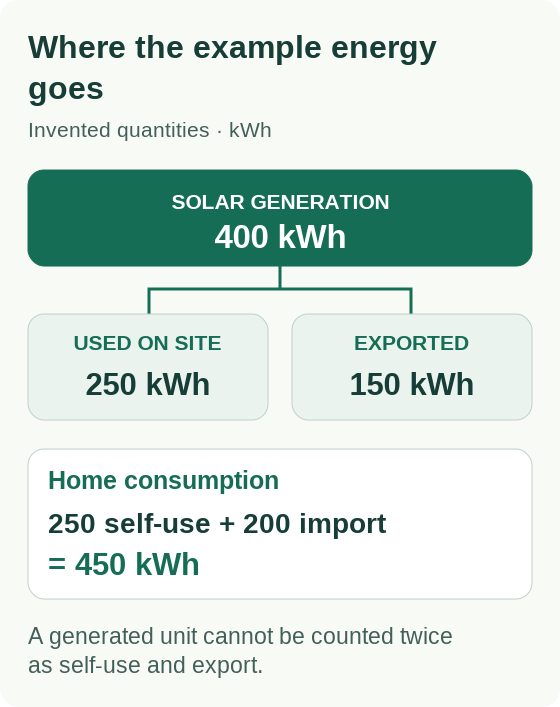
The example below uses the same energy quantities as the old example on this page, so you can compare the two arrangements directly. It is a worked example with reported figures, not a promise about any real bill: your slab rate, your fixed charges, your taxes and the export rate actually applied to you will all differ. Check each of them on your own bill.
Imagine a system produces 400 kWh in a month. The home directly uses 250 kWh of that solar energy during the day, and 150 kWh is exported to the grid. The home also imports 200 kWh from the grid, mostly at night. Total energy used in the home is 450 kWh in this simplified example.
| Quantity | Illustrative kWh |
|---|---|
| Solar generation | 400 |
| Used directly in the home (self-consumption) | 250 |
| Exported to the grid | 150 |
| Imported from the grid | 200 |
| Home consumption in this example | 450 |
Under net billing, the import and the export are priced separately:
- Import charge: 200 imported units × your slab tariff. As an assumed example only, at Rs 45 per unit — inside the roughly Rs 37–55 range reported for higher slabs — that is 200 × Rs 45 = Rs 9,000. Your slab rate will be different; it is printed on your bill, and you can check what imported units cost at your slab on the /electricity-bill-calculator/.
- Export credit: 150 exported units × the reported export rate. At Rs 10 per unit that is 150 × Rs 10 = Rs 1,500; at Rs 11 per unit it is Rs 1,650. Some reports put the rate as low as around Rs 8, which would give Rs 1,200. The regulation does not fix the figure, so use the rate shown on your own bill.
- Energy charge before other lines: Rs 9,000 − Rs 1,500 = Rs 7,500 at a Rs 10 export rate (Rs 7,350 at Rs 11). Fixed charges, taxes, surcharges and any adjustments are then added on top — they are not included in this Rs 7,500 figure, and they do not disappear because you have solar panels. See /electricity-bill-taxes-explained/ for what those lines are.
Now compare the same month under the old net metering rules. The 150 exported units would have cancelled 150 imported units one for one, leaving only 50 imported units to pay for: 50 × Rs 45 = Rs 2,250 before other lines, instead of Rs 7,500. That is the whole story of the February 2026 change in one pair of numbers — the same panels, the same sunshine and the same household use produce a much larger energy charge, because exported units are now worth roughly Rs 10–11 instead of roughly Rs 26.
The example also shows where the real saving sits under net billing. The 250 units the home used directly never appear on the import side of the bill at all: each one is an imported unit the household did not have to buy. At the assumed Rs 45 example rate, that self-consumption is worth 250 × Rs 45 = Rs 11,250 of electricity the household did not buy — far more than the Rs 1,500 export credit for the 150 exported units. That is why installers and guides now advise sizing a system to daytime use rather than to maximum export: shifting washing, water pumping, ironing and other flexible loads into daylight hours, when the panels are producing, is worth more than exporting those units. Our guide to /wapda-peak-hours-saving-guide/ explains how the timing of use affects the bill.
Two warnings belong with this example. First, a single month proves nothing: generation falls in cloudy and winter months, household use changes, and the export rate can be revised, so a payback figure based on one good month will overstate the return. Second, if a proposal shows you a bill of nearly zero, ask which export rate it assumed, which slab rate it assumed for imports, and which fixed charges and taxes it left out — then check each answer against your own bill before you sign.
Who can apply for net billing, and how to apply
Who can apply
Under the Prosumer Regulations 2026, an applicant must be a three-phase 400 V or 11 kV consumer of a distribution company (DISCO). The regulations cover domestic, commercial, industrial, agricultural, general services and bulk-supply consumers who meet that condition. A single-phase home cannot apply as it stands — it must first be converted to a three-phase connection. If that applies to you, start with our /new-electricity-connection-guide/ and ask your DISCO what a three-phase conversion involves for your connection before you buy panels.
Your system must also fit your connection. The maximum system size is your sanctioned load, with an overall cap of 1 MW — you cannot install a system larger than the load your connection is sanctioned for. And the financial terms split at 25 kW: systems of 25 kW or below are approved by your DISCO and pay no NEPRA licence fee; systems above 25 kW pay Rs 1,000 per kW and need NEPRA concurrence as well as DISCO approval. The fee exemption for smaller systems was withdrawn by amendment in April 2026 (S.R.O. 709(I)/2026) with retrospective effect from 9 February 2026, and the shift of approval for systems up to 25 kW from NEPRA to the DISCO came in the August 2026 amendment (S.R.O. 1330(I)/2026, 6 August 2026).
How to apply — through your DISCO
The process runs through your local distribution company — LESCO in Lahore, IESCO in Islamabad and Rawalpindi, K-Electric in Karachi, and MEPCO, PESCO, FESCO, GEPCO, HESCO, SEPCO and QESCO in their regions. LESCO customers can find LESCO-specific bill and contact guidance on our /lesco-bill/ page. The steps below are the standard route described in the DISCO application checklists published with the regulations; your DISCO's current form, fee and document list is the final word, so confirm each step with it before you pay anything.
- Confirm your eligibility. Check your connection type (three-phase or not), your sanctioned load and the system size you are considering. The system cannot exceed your sanctioned load.
- Choose a certified installer and get a written design. Use an installer with verifiable certification, a proper office you can return to, and a design sized to your daytime use rather than to maximum export. Ask which installer certification your DISCO currently accepts, and get the panel and inverter serial numbers written on your invoice — that protects your warranty as well as your application.
- Prepare your documents. The usual file is your CNIC, your latest paid electricity bill, proof of ownership or the owner's written consent, the panel and inverter datasheets, and a single line diagram of the proposed system. Your DISCO may ask for more; use its current checklist, not a checklist from an old article.
- Submit the application. Apply through the PITC net billing portal (nmp.pitc.com.pk) or at your DISCO's customer service centre. The DISCO gives you the application forms free of charge.
- Technical review and inspection. The DISCO reviews the application and inspects the installation for technical compliance — proper earthing, protection devices, and an inverter that disconnects from the grid during outages (anti-islanding). Fix anything the inspection flags and keep the written record of the inspection.
- Sign the agreement and pay the demand notice. Once the installation passes, you sign the prosumer interconnection agreement with the DISCO — under the new rules this runs for 5 years, renewable by mutual consent — and pay the demand notice for the bidirectional meter and interconnection. Keep the paid demand notice safe; it is your proof of payment.
- Meter installation and billing. The DISCO installs and calibrates a bidirectional (green) meter, which records imported and exported units separately, and starts billing import and export separately under net billing. Check the first two bills line by line against your agreement: the import units, the export units, the export rate applied and the fixed charges. Our guide to /ami-smart-meters-pakistan/ explains how to read the import and export registers on a modern meter.
No fixed approval time is stated here: DISCO timelines vary, so ask your DISCO for its current timeline when you submit. Do not pay any fee that is not on the DISCO's own demand notice, and do not let an installer start work on the promise of approval before the application is accepted.
What happens to existing agreements signed before 9 February 2026
If you already have solar panels connected under the old net metering rules, the February 2026 change does not automatically move you to net billing. NEPRA amended the regulations on 2 April 2026 (S.R.O. 547(I)/2026), with retrospective effect from 9 February 2026, to protect qualifying existing agreements. A valid agreement signed under the old rules before 9 February 2026 — and, as reported, an application filed by 8 February 2026 — keeps the old rate and the old billing method until that agreement expires. In practice that means your exported units keep being valued at the old level, reported at roughly Rs 26 per unit, and keep offsetting imported units as before, for the remainder of your agreement's term.
Three conditions limit that protection, and each one is worth checking on your own paperwork. First, the agreement must be a valid one executed under the repealed 2015 regulations — if you only had a quotation, a booking or an incomplete application, ask your DISCO in writing which rules apply to you rather than assuming you are protected. Second, the protection lasts only until the agreement expires. When it ends, renewal is under the new rules: the renewed agreement is a net billing agreement, with the 5-year term and the NAEPP export rate described above. Third, the protection can end early if you make a material modification that changes your system's maximum electrical output — for example, adding more panels. Before accepting any expansion quotation for an existing system, get written confirmation from your DISCO of how the change would affect your billing treatment; adding capacity can cost you the old terms, and the extra generation may be worth less than the old rate you give up.
To find out where you stand, look at three documents: your signed agreement (its date and its expiry date), your approval or commissioning record, and your recent bills (which show whether exports are still offsetting imports or are already being credited separately). If the bill does not match the agreement, raise it with your DISCO with those documents in hand, and keep copies of everything. If you are buying a house with an existing solar connection, ask the seller for the agreement and check its expiry date before you agree a price — the remaining old-rule years are worth real money, and they end on the date in the agreement, not when you move in.
Ask for these items before accepting a proposal
- Which agreement and current regulation will apply to this connection?
- What import and export treatment is assumed, and where is its official source?
- How much output is assumed to be self-consumed rather than exported?
- Which fixed charges, taxes, maintenance and replacement costs are excluded?
- What happens to the estimate if generation, use or applicable prices change?
Keep the assumptions with any savings estimate. A single best-case payback number does not show how the result changes if daytime use is lower or the settlement terms differ.
When the solar bill does not match expectations
Compare the import/export readings and billing period with the agreement and the provider’s statement. Ask which rate and adjustment was applied to each quantity. Preserve approval documents and any case references when seeking a correction.
Use the provider’s authorised connection and metering process; electrical installation and protection must be handled by qualified people under the applicable requirements. This page is a billing guide, not wiring or interconnection instructions.
Frequently asked questions
Is net metering still available in Pakistan in 2026?
No, not for new connections. Since 9 February 2026, NEPRA's Prosumer Regulations 2026 (S.R.O. 251(I)/2026) replaced net metering with net billing for every new solar connection. Only agreements signed before 9 February 2026 keep the old net metering terms, and only until they expire.
What is the net billing export rate in Pakistan?
Exported units are credited at the national average energy purchase price (NAEPP). The regulation does not print a rupee figure. The rate was reported at roughly Rs 10–11 per unit when the rules were notified in February 2026, and as low as around Rs 8 in some reports, so the reported range is Rs 8–11 per unit. NEPRA can revise it by notification, so check the rate on your own DISCO bill or the current NEPRA notification.
Why is my solar bill higher than the installer promised?
Most often because the estimate used the old net metering arithmetic: exported units valued at roughly Rs 26 each and offsetting imports one for one. Under net billing, exports earn roughly Rs 10–11 per unit while imports are billed at your full slab tariff, so the same system produces a larger bill. Ask the installer which export rate, slab rate, fixed charges and taxes the estimate assumed, and check each one against your bill.
I already have a net metering agreement. Do I need to do anything?
No, if your agreement was validly signed before 9 February 2026. Under S.R.O. 547(I)/2026 (2 April 2026), it keeps the old rate and billing method until it expires. Check the expiry date in your agreement, because renewal after expiry is under net billing. Do not expand the system without written confirmation from your DISCO, as a change to its maximum output can end the old terms early.
Can I add more panels to my existing net metering system?
You can, but it may cost you the old terms. The April 2026 amendment protects existing agreements unless there is a material modification that changes the system's maximum electrical output. Adding panels is such a change. Get written confirmation from your DISCO of the billing treatment before you add capacity.
How big a solar system can I install, and who approves it?
Up to your sanctioned load, with an overall cap of 1 MW, and only if you are a three-phase 400 V or 11 kV consumer. Systems up to 25 kW are approved by your DISCO with no NEPRA licence fee. Systems above 25 kW pay Rs 1,000 per kW and need NEPRA concurrence as well. New agreements run for 5 years, renewable by mutual consent.
Sources & scope
The sources below explain the rule or service discussed on this page. Use your DISCO's records and your signed agreement for an individual account. Rates and procedures change, so check the current NEPRA notification and your own bill before acting.
- NEPRA (Prosumer) Regulations, 2026 — S.R.O. 251(I)/2026, notified 9 February 2026. The regulations that repealed the 2015 net metering regulations and introduced net billing for new connections. Consult the full text on NEPRA's official website (nepra.org.pk, legal register).
- NEPRA amendment — S.R.O. 547(I)/2026, 2 April 2026. Amended regulation 21(2) so that valid agreements executed under the old rules before 9 February 2026 keep the old rate and billing method until expiry, with retrospective effect from 9 February 2026, subject to the material-modification exception.
- NEPRA amendment on fees — S.R.O. 709(I)/2026, 28 April 2026. Withdrew the licence and fee requirement for systems of 25 kW or below, backdated to 9 February 2026.
- NEPRA amendment on approval — S.R.O. 1330(I)/2026, 6 August 2026. Systems of 25 kW or below are approved by the DISCO rather than needing NEPRA concurrence. (Citation note: some secondary sources cite this amendment as S.R.O. 1320(I)/2026. The number used here, S.R.O. 1330(I)/2026, was confirmed against NEPRA's own register — the notified PDF on nepra.org.pk is filed as 'SRO 1330(I)-2026 Dated 06-08-2026'. Keep 1330; the 1320 citation is incorrect.)
- NEPRA legal register (nepra.org.pk). Lists the Prosumer Regulations 2026 and the subsequent amendments. Consult the full applicable texts; summaries on this page do not replace them.
- Dawn, 10 and 12 February 2026. Reporting on the notification of the Prosumer Regulations 2026, the shift to net billing, and the export rate reported at roughly Rs 10–11 per unit (with the import tariff reported at roughly Rs 37–55 per unit for higher slabs).
- PIDE (Pakistan Institute of Development Economics), 2026 — "From Net Metering to Net Billing". Research note on the change from net metering to net billing, putting the export credit at about Rs 10–11 per kWh against about Rs 25–26 under the old arrangement.
- PITC net billing portal (nmp.pitc.com.pk). The portal through which prosumer applications are submitted to the DISCO, alongside applications at DISCO customer service centres. Verified loading (HTTP 200) on 21 November 2026.
- Your DISCO and your signed agreement. The DISCO's current application checklist, demand notice and your agreement govern your connection. Official bills and DISCO decisions take priority over any guide.
Scope and limits. This page is a billing guide. It does not give legal advice, and it is not wiring or interconnection instructions. The export rate is not fixed in the regulations and can be revised by NEPRA notification; figures quoted here are reported figures, labelled as such, and the rate on your bill is the one that applies to you. Application steps follow the DISCO checklists published with the regulations; individual DISCOs may ask for different documents or follow different timelines, so confirm the current requirements with your DISCO before you apply or pay. The page was prepared on 21 November 2026; check the sources above for anything notified after that date.
Last updated: November 2026.